Bitcoin and Decentralized finance
Introduction: A New Financial Architecture Is Being Built
The global financial system is undergoing its most profound structural challenge since the abandonment of the gold standard in 1971. Governments are spending at historically unprecedented levels, central banks are expanding money supplies with diminishing restraint, and the purchasing power of traditional currencies is eroding in ways that are becoming impossible to ignore. Against this backdrop, a parallel financial architecture — built on blockchain technology, cryptographic trust, and mathematical scarcity — is quietly maturing from a speculative experiment into a legitimate structural alternative.
At Alfred Vault, we do not view Bitcoin and decentralised finance through the lens of hype or speculation. We view them through the lens of long-term structural necessity — understanding both the genuine strengths and the honest limitations of these technologies, and their role in a world where the relationship between governments, money, and value is being fundamentally renegotiated.

what is Bitcoin?
THE TECHNOLOGY — WHAT BITCOIN ACTUALLY IS
The Distributed Ledger: A Higher-Level View
Bitcoin is built on blockchain technology — a concept that is simultaneously simple in its core logic and profound in its implications. A blockchain is a decentralised ledger of all transactions across a peer-to-peer network. Using this technology, participants can confirm transactions without a need for a central clearing authority. Synovus In practical terms, this means that for the first time in economic history, two parties anywhere in the world can transact with finality, transparency, and security — without the involvement of a bank, government, or any trusted intermediary.
The architecture works as follows. Transactions are grouped into blocks of data. Each block contains a cryptographic fingerprint — a hash — of the previous block, creating a chronological chain that is computationally impossible to alter retroactively without redoing the work of every subsequent block simultaneously across the entire network. This distributed design makes the ledger secure, transparent, and tamper-resistant — no single entity controls it, and no single point of failure exists. iQuasar
Consensus and Proof of Work
For a decentralised network with no central authority to function, it must have a mechanism by which thousands of independent participants agree on the truth. Bitcoin solves this with Proof of Work — a consensus mechanism in which network participants, known as miners, compete to solve computationally intensive mathematical puzzles. The winner adds the next block to the chain and receives newly issued Bitcoin as a reward. This system has several elegant properties: it makes fraudulent transactions economically irrational, it creates a verifiable record of computational effort that cannot be faked, and it ties the issuance of new Bitcoin to real-world energy expenditure rather than political decision-making.
Fixed Supply: The Property That Changes Everything
Bitcoin's supply is determined by the protocol, not a central bank. The network is completely decentralised and has no physical form — it exists only in the network. Synovus The total supply is permanently capped at 21 million coins, enforced by code that no government, corporation, or individual can override. This fixed supply is not merely a technical detail — it is Bitcoin's most fundamental economic property, and the one that distinguishes it most sharply from every fiat currency ever created.
Approximately every four years, a mechanism called the halving reduces the rate at which new Bitcoin is issued by 50%. The most recent halving occurred in April 2024, reducing the block reward to 3.125 Bitcoin per block. This programmatic scarcity means Bitcoin's inflation rate is not only low — it is predictably and permanently declining, eventually approaching zero. No government can decide to print more of it. No central bank can expand its supply in response to a crisis. This is a feature, not a limitation.
CHAPTER TWO: DECENTRALISED FINANCE — WHY IT IS NEEDED
The Limitations of the Traditional System
The traditional financial system rests on a network of trusted intermediaries — banks, brokers, clearinghouses, payment processors — each of which takes a fee, introduces latency, and imposes conditions on access. For citizens of stable, well-governed economies with strong banking infrastructure, these frictions are tolerable. For the estimated 1.4 billion adults globally who remain unbanked, or for the hundreds of millions more who live in countries with unstable currencies, capital controls, or chronically dysfunctional banking systems, the traditional financial system is not merely inconvenient — it is a structural barrier to economic participation.
Decentralised Finance — DeFi — leverages smart contracts to create financial systems that are open, trustless, and often offer better rates than traditional finance. Users have more control over their assets, enhancing privacy and reducing reliance on centralised institutions. Federal News Network Smart contracts are self-executing agreements written in code and deployed on blockchain networks — they run exactly as programmed, without the possibility of interference, censorship, or counterparty default.
DeFi Is Maturing Into Infrastructure
DeFi has matured significantly. The integration of DeFi with traditional finance represents a fundamental shift, offering businesses unprecedented access to financial services and private markets. Institutional-grade lending protocols now provide competitive rates and robust security measures, while advanced yield optimisation strategies enable more efficient treasury management. Govwin
DeFi is projected to expand significantly in 2026 and beyond, remaining a dominant force in the crypto space. The DeFi market could reach a $100 billion valuation as more platforms solidify their roles within the ecosystem — more than double compared to 2025 — with tokenised securities and high-value assets catalysing its growth and attracting both retail and institutional investors. Winvale
The convergence of clearer regulatory frameworks, increasing enterprise-grade deployment, and improving interoperability is pushing blockchain from experimental applications to the foundations of a new digital financial market infrastructure. Financial services companies across the value chain — including asset managers, financial market infrastructures, payment providers, fintechs, and investors — are incorporating blockchain-enabled solutions to reduce friction, improve transparency, and lower transaction costs. PeopleSolutions
Swift, the secure messaging network connecting more than 11,000 financial institutions globally, announced in September 2025 that it will work with more than 30 financial institutions to develop a shared digital ledger, with an initial focus on real-time 24/7 cross-border payments. The Birmingham Group When the institution that underpins global interbank communication begins building on blockchain rails, the technology has crossed definitively from fringe to foundation.
The Regulatory Turning Point
The United States established a Strategic Bitcoin Reserve by executive order on March 6, 2025 — making it the official policy of the United States to hold Bitcoin as a strategic national asset alongside other digital assets. Construction Dive The GENIUS Act, passed by Congress in July 2025, created a comprehensive framework for regulating stablecoins, establishing rules for issuers, reserves, consumer protection, and anti-money laundering compliance — providing the regulatory certainty that institutional participants had long required before committing capital at scale. The Birmingham Group
These are not marginal developments. They represent the formal integration of decentralised financial infrastructure into the sovereign policy frameworks of the world's largest economy — a legitimisation that accelerates institutional adoption and creates the compliance infrastructure for DeFi to operate alongside, rather than in opposition to, traditional finance.
CHAPTER THREE: GOVERNMENT SPENDING, MONEY SUPPLY, AND THE DEBASEMENT OF TRADITIONAL ASSETS
The Invisible Tax Nobody Voted For
Debasement refers to the devaluation of a currency when the money supply grows faster than real economic output. When new money is created, the same value is distributed across more units, and each unit loses purchasing power. The Roman Empire reduced the silver content of coins to finance the state, leading to rising inflation and a loss of confidence in the currency. U.S. Bank The mechanism has not changed in two thousand years — only the instruments have become more sophisticated and the scale more vast.
The modern equivalent of clipping coins is central bankers and treasury officials inflating the money supply through money printing and expansive fiscal policy. The dollar's 9% decline year-to-date in 2025, coupled with gold's 65% surge over the year and Bitcoin's rally, has given the debasement narrative mainstream credibility. Morgan Stanley
The Scale of the Problem Is Historic
Debt held by the public now equals approximately 99% of US GDP — nearly the size of the whole economy. The Congressional Budget Office projects it will exceed 100% by 2026, reach 122% by 2034, and could hit 172% by 2054 — far above the previous record of 106% set during World War II. In dollar terms, publicly held debt stands at around $30.6 trillion, with annual budget deficits expected to climb from $1.9 trillion to $2.8 trillion over the next decade. J.P. Morgan
The US government ran a budget deficit of $1.8 trillion in fiscal 2025 and is on track for another trillion-dollar deficit during fiscal 2026, which will propel the national debt to even greater heights and stoke further fears about the growing money supply and weakening dollar. The Federal Reserve has cut interest rates six times since September 2024 and recently ended its quantitative tightening programme, actively buying government-backed securities once again and increasing the size of its balance sheet. Morningstar
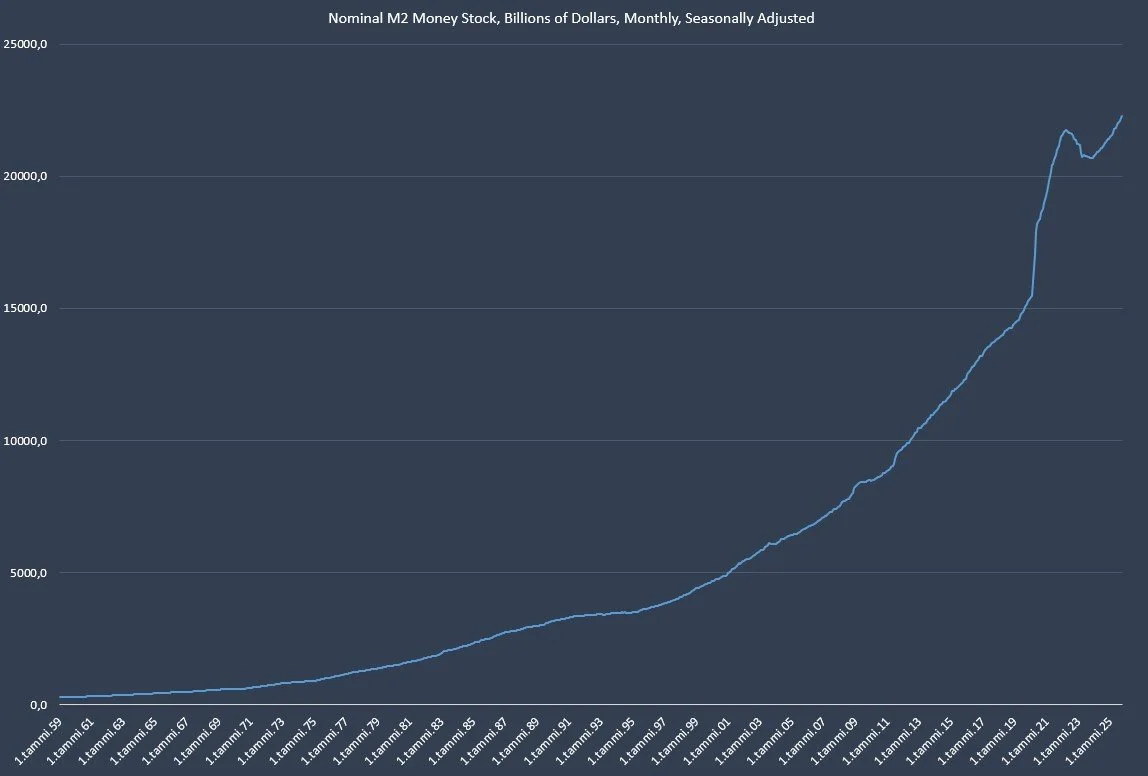
Nominal M2 Money stock, Billions of dollars, Monthly, Seasonally adjusted. Source: https://fred.stlouisfed.org/series/M2SL#
The IMF warns that worldwide public debt will exceed 100% of global GDP by 2029 — the highest since the 1940s. J.P. Morgan This is not a uniquely American problem. It is a global structural condition that has been building for decades and has no painless resolution. Governments can raise taxes, cut spending, grow their way out, inflate their way out, or default. Of these options, history strongly suggests that inflation — the silent erosion of purchasing power — is the path of least political resistance.
What Happens to Traditional Assets
Up until 1971, the US was on the gold standard, which prevented the government from printing paper money unless it had an equivalent amount of physical gold to match. After abandoning that mechanism, money supply exploded, and the purchasing power of the US dollar has collapsed by approximately 90% since then. Morningstar Every dollar held in cash today buys roughly one-tenth of what it bought in 1971. This is not a theoretical risk. It is a documented historical reality — and the policy trajectory of the 2020s suggests the pace of debasement is accelerating rather than slowing.
The debasement trade describes an investment strategy where capital flows into assets that cannot be arbitrarily multiplied. The goal is to preserve value when fiat currencies lose trust. Global debt is at a historic high. Governments cover budget deficits by creating new money, while the purchasing power of the euro, the dollar, and other fiat currencies continues to decline. U.S. Bank
Bitcoin's Elastic Relationship With Money Supply
Cointegration analysis from January 2015 to April 2025 found a long-run elasticity of 2.65 between Bitcoin's price and the US M2 money supply — meaning a 1% increase in M2 corresponded to a 2.65% rise in Bitcoin's price. This suggests Bitcoin acts as a highly elastic asset in response to monetary expansion. Deloitte Insights Bitcoin also demonstrates an inverse correlation with the US Dollar Index, often moving in opposition to the dollar's strength — a relationship that aligns logically with its fixed supply model.
AN HONEST ASSESSMENT: BITCOIN'S LIMITATIONS AS A HEDGE
Alfred Vault believes that intellectual honesty is a prerequisite for credible investment analysis. And intellectual honesty requires acknowledging that Bitcoin's credentials as a short-term inflation hedge are contested by recent evidence.
While Bitcoin advocates have long marketed the cryptocurrency as protection against inflation, recent market behaviour has challenged this narrative. Gold gained 64% in 2025 and despite a recent fall was still up approximately 10% in 2026, while Bitcoin experienced a more than 50% collapse from its peak over the same period — its steepest single-day decline on February 5, 2026 since the FTX collapse in November 2022. CBS News
Bitcoin's correlation to the S&P 500 has at times surpassed 0.9 over the past three years — far higher than gold's near-zero correlation to equities. These factors make Bitcoin appear to be more of a leveraged bet on risk appetite than a genuine hedge against monetary debasement. Morgan Stanley For Bitcoin to earn its inflation hedge reputation, it needs to show consistent inverse correlation with real interest rates and dollar strength. So far in 2025 and into 2026, it has failed that test repeatedly. Cambridge Currencies
The honest conclusion is that Bitcoin is not yet a reliable short-term inflation hedge in the manner that gold has proven to be over centuries. Its behaviour in acute risk-off environments more closely mirrors high-beta technology stocks than defensive stores of value. This is a meaningful limitation that investors must price into any allocation decision.
Alfred Vault: A Long-Term Structural Thesis
Our view on Bitcoin and decentralised finance is grounded in long-term structural thinking rather than near-term price prediction. The technology is real, the need is genuine, and the macro forces driving debasement are accelerating. These are durable conditions that do not resolve quickly.
There are legitimate reasons to be constructive on Bitcoin's long-term prospects: growing institutional adoption following ETF approvals, improving regulatory clarity in major markets, and its role as a scarce digital asset in an increasingly digital economy. Deloitte Insights The establishment of a US Strategic Bitcoin Reserve, the passage of comprehensive stablecoin legislation, and Swift's integration of blockchain rails into global payment infrastructure are not speculative signals — they are structural anchors.
The debasement of fiat currencies is not a prediction. It is a mathematical consequence of the fiscal and monetary policies already in motion. Bitcoin's fixed cap of 21 million coins provides digital protection against monetary devaluation that operates independently of political decisions. U.S. Bank Whether that property commands a price premium in any given quarter is a trading question. Whether it represents a structurally important property in a world of unlimited government money printing is a strategic one. Alfred Vault is focused on the latter.
We are in the early chapters of a long transition — from a world where financial trust is centralised in institutions, to one where it is distributed across mathematics, code, and consensus. That transition will be volatile, contested, and non-linear. But the direction, in our assessment, is clear.
This content represents the views and perspectives of Alfred Vault and is provided for informational and educational purposes only. It does not constitute investment advice. Please refer to our full disclaimer.
