AI Infrastructure
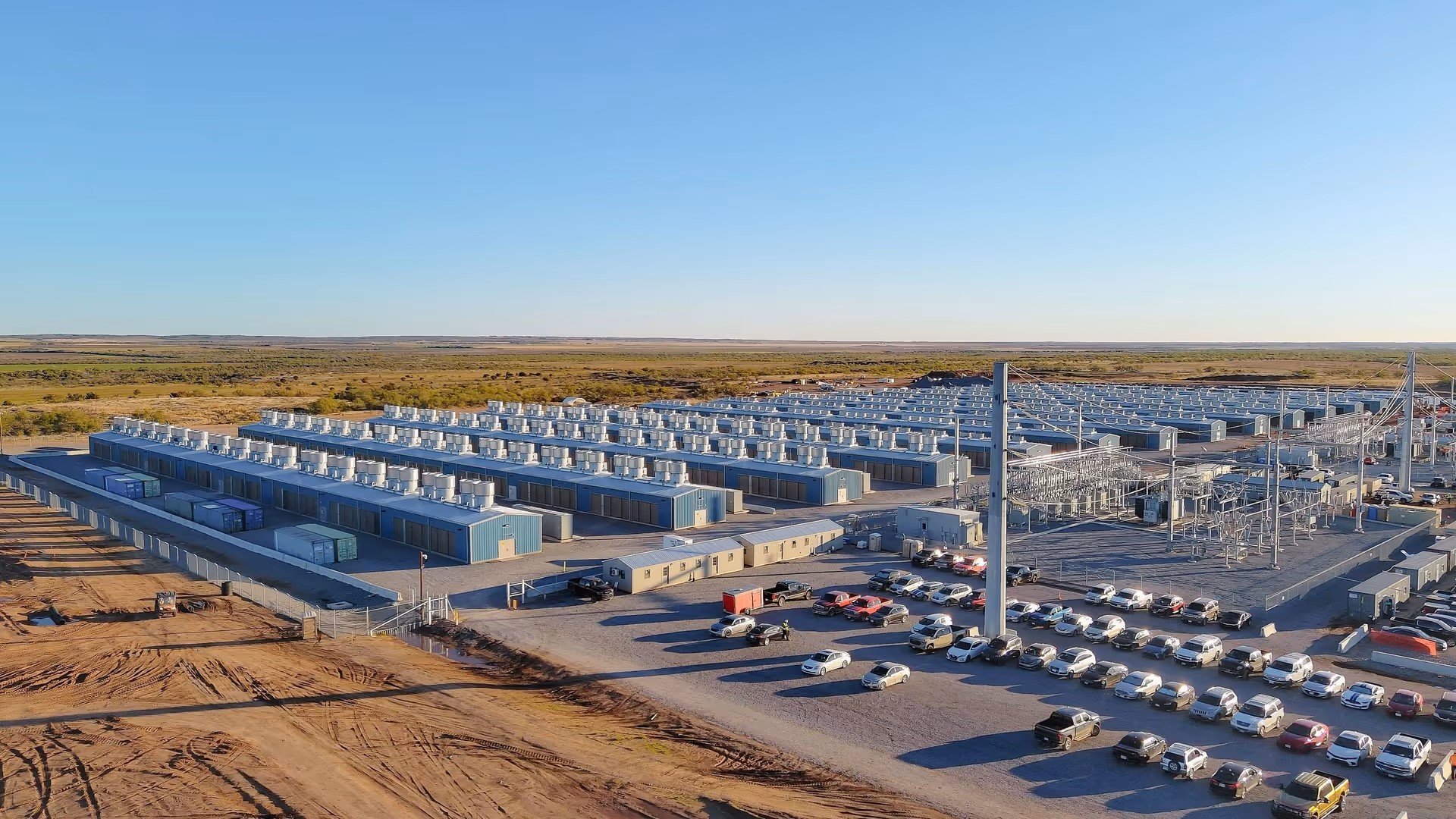
IREN Limited, Childress Data Center with 750 MW Capasity
The Constraint No One Is Talking About Enough
The AI revolution has a physical problem. Behind every large language model, every inference query, and every autonomous agent lies an enormous and growing appetite for electricity — and the world's power infrastructure was simply not built to feed it. While the headlines celebrate the capabilities of AI systems, the investment story of the next decade may be written not in software, but in substations, transmission lines, cooling systems, and nuclear reactors or alternative energy sources.
Corporate investments in AI, particularly in data center construction, drove over one-third of US GDP growth in the first nine months of 2025 alone. The Birmingham Group After nearly two decades of flat consumption, US electricity demand is now climbing again — the first sustained increase in almost 20 years — driven by data centers, AI, EV adoption, and the electrification of heating and industry. Cambridge Currencies This is not a cyclical blip. It is a structural transformation of energy demand, and the infrastructure required to serve it represents one of the most capital-intensive investment opportunities of our generation.
The Scale of the Demand Shock
The numbers are difficult to absorb. Total AI data center power demand reached approximately 21 GW in 2025 — a more than fourfold increase from 2023 levels, and more than the entire power capacity of the state of Utah. Federal News Network That figure is projected to reach 68 GW globally by 2027 — close to California's total power capacity — and potentially 327 GW by 2030, compared with just 88 GW of total global data center capacity as recently as 2022. iQuasar
The IEA's base case projects global electricity consumption for data centres to double to around 945 TWh by 2030, representing nearly 3% of total global electricity consumption. Winvale Goldman Sachs forecasts data center power demand will increase 50% by 2027 and by as much as 165% by the end of the decade compared to 2023. Govwin In the United States alone, data centers are already anticipated to represent 6% of total national electricity consumption in 2026. Synovus
To put this in physical terms: there are 50,000-acre data center campuses in early-stage development that could each consume 5 GW — equivalent to the power needed for five million residential homes and more than the capacity of the largest existing nuclear or gas plants in the United States. iQuasar This is infrastructure at a scale that the energy system has never before been asked to accommodate in such a compressed timeframe.
The Grid Connection Bottleneck: Time to Market Is the Real Constraint
Here is where Alfred Vault's thesis sharpens. The limiting factor in AI infrastructure deployment is not capital, ambition, or even technology — it is the physical impossibility of connecting new power demand to a grid that was designed for a different era.
Before a large generator plant can connect to the grid, the operator must study whether the local and regional system can handle it. If not, upgrades are triggered — substations, transformers, transmission lines, and protection systems — all of which take years to permit, procure, and build. Data centers can be built in months. Grid capacity cannot. Morgan Stanley
Grid connection requests are taking four to seven years in key regions like Virginia — the most data center-dense state in the world. iQuasar Utility five-year peak demand growth forecasts surged from 38 GW in 2023 to 128 GW in 2024 — a more than threefold increase in the industry's own projections in a single year. Market Xcel The system is already straining under demand that has not yet materialised at full scale.
The human response to this constraint has been instructive. Elon Musk fired up the Colossus AI data center in July 2024 while a 150 MW substation was still under construction on the site — turning to private gas turbines to deliver immediate power rather than wait for grid connection. OpenAI subsequently ordered 29 gas turbines capable of producing 34 MW each for its Stargate data center in Abilene, Texas. CBS News On-site generation and bridging power solutions are now becoming necessary components of any serious AI deployment strategy — and 2026 marks only the beginning of this electrification process, which will continue to shape the next decade of infrastructure growth. PeopleSolutions
Substations and the Physical Ecosystem Around Data Centers
The substation has become one of the most strategically valuable pieces of infrastructure in the AI economy. A large-scale AI data center requires not just raw power generation, but a dedicated, high-capacity substation capable of stepping down transmission-level voltage to the data center's operating requirements — typically in the range of 115 kV to 33 kV or lower. Building or upgrading such a substation requires specialised high-voltage transformers, which face lead times of 18–24 months from manufacturers that are already running at capacity.
Smarter substations and automated restoration are now being identified as central requirements for grid reliability in data center regions, with utilities increasingly deploying new technologies to improve the efficiency of existing facilities and accelerate engineering, siting, and permitting timelines. Morningstar
Beyond the substation itself, the physical campus ecosystem surrounding a large AI data center has expanded dramatically. Modern AI data center campuses require dedicated cooling infrastructure — liquid cooling systems now essential for high-density GPU racks — physical security perimeters, backup generation facilities, high-capacity fibre connectivity, and increasingly, on-site energy storage in the form of battery energy storage systems. Computing power and cooling each account for approximately 38–40% of data center electricity consumption, making both targets for continuous efficiency investment. Synovus Battery energy storage systems have shifted from backup accessories to core mission-critical infrastructure, helping operators smooth demand peaks, reduce reliance on fossil-fuel backup generation, and deepen integration with renewable energy sources. Morningstar
Nuclear Energy: The Balancing Power the Grid Actually Needs
The intermittency problem lies at the heart of the AI power challenge. Solar and wind are insufficient on their own for AI data center operations, which require 24-hours-a-day, 7-days-a-week power delivery with extremely high reliability standards. A data center cannot simply pause computation during a cloudy, windless afternoon. This fundamental requirement — firm, dispatchable, around-the-clock power — has brought nuclear energy back to the centre of the energy conversation after decades on the periphery.
Technology giants including Microsoft, Google, Amazon, and Meta have all signed nuclear power agreements or invested directly in reactor development. Speed, reliability, and 24/7 availability have become critical factors, and the IEA expects clean power including nuclear to play a significantly larger role after 2030 as installed capacity grows. J.P. Morgan
Microsoft has recommissioned the old Three Mile Island nuclear power plant to deliver 819 MW of power for AI and cloud data centre usage — expected to be operational by 2028. CBS News US executive orders now aim to increase nuclear energy capacity from 100 GW to 400 GW by 2050, with a target of 10 newly designed large reactors under construction by 2030 and 5 GW of additional capacity from upgrades to existing reactors. Retired coal plant sites across the US have been identified as capable of hosting up to 174 GW of new nuclear capacity, offering faster development timelines and existing grid connections. J.P. Morgan
Small modular reactors represent the most commercially exciting near-term nuclear opportunity. Geothermal and nuclear including SMRs offer long-term solutions to AI's rising energy demand, but scaling them requires coordinated investment, R&D support, and demonstration at pace. Deloitte Insights With no SMRs currently in commercial operation in the US and permitting and construction cycles often spanning five to seven years, first units are unlikely before late this decade, with repeatable commercial deployment more likely in the 2030s. Morningstar The caveat is important: nuclear is a long-term solution, not a near-term one. The grid needs balancing power now — and that reality is driving a parallel, short-term surge in natural gas infrastructure that itself represents a significant investment theme.
Alfred Vault’s conclusion: Energy as the New Commodity
This is where the infrastructure challenge transforms into an investment opportunity — and why Alfred Vault views reliable, dispatchable electricity as the defining commodity of the AI era, in the same way that oil was the defining commodity of the industrial era.
It is estimated that AI data centers could generate $10 to $12 billion per gigawatt of capacity annually. CBS News Power secured, infrastructure connected, and cooling operational translates directly into revenue at an extraordinary rate. The companies that control reliable, grid-connected power capacity in proximity to major AI deployment corridors hold an asset that is functionally scarce and structurally appreciating.
Global data center infrastructure spending is projected to approach $7 trillion over the next five years, with the bulk of capital flowing into servers and the chips that drive modern data center performance. CNBC But Alfred Vault's thesis extends beyond the data centre itself into the enabling layers: power generation assets, transmission and substation infrastructure, cooling technology, battery storage systems, and the nuclear supply chain or alternative energy source.
The opportunity cascades across multiple layers. Utilities investing in grid upgrades benefit from regulated rate increases. Dominion Energy proposed its first base-rate increase since 1992 in February 2025, directly attributing the increase to data center load growth in Virginia. Morningstar Power companies with existing grid-connected generation capacity near data center corridors command substantial premiums. Equipment manufacturers producing high-voltage transformers, switchgear, and cooling systems face multi-year order backlogs. Nuclear fuel processors and uranium producers are beneficiaries of the long-cycle transition. And the operators who can solve the time-to-market problem — delivering power-ready, connected, cooled data centre capacity faster than competitors — will capture the most acute pricing premium in the industry.
Alfred Vault's Conclusion: Infrastructure Is the Durable Edge
Those operators that can provide AI-ready, sustainable digital infrastructure at speed will be able to capitalise on the industry's exponential expansion — time to market is a fundamental factor in this race. PeopleSolutions
History teaches us that the most durable fortunes in a technology revolution are made not always in the technology itself, but in the infrastructure that enables it. The railroad barons who owned the land, the right-of-way, and the stations often outlasted the locomotive manufacturers. The utilities that electrified American factories captured more stable, compounding value than many of the electrical device makers they powered.
The AI era will follow this pattern. Electricity, substations, grid connections, cooling systems, nuclear baseload, and battery storage are not peripheral to the AI investment thesis — they are the foundation upon which all of it is built. At Alfred Vault, we believe that investors who understand this infrastructure layer — who can identify which assets are genuinely scarce, which time-to-market solutions are credible, and which balancing power providers will emerge as critical utilities of the digital economy — are positioned to capture one of the most compelling and durable investment opportunities of the coming decade.
The intelligence revolution runs on electricity. And electricity, for the first time in a generation, is becoming genuinely scarce.
This content represents the views and perspectives of Alfred Vault and is provided for informational and educational purposes only. It does not constitute investment advice. Please refer to our full disclaimer.
